Wednesday, August 09, 2006

Animals

This is from the same herd as I posted a few months back. These pictures are taken from my camera though.
I can't remember the name of these deer-like but not spinboks creatures.
And crossing...

The Transkei

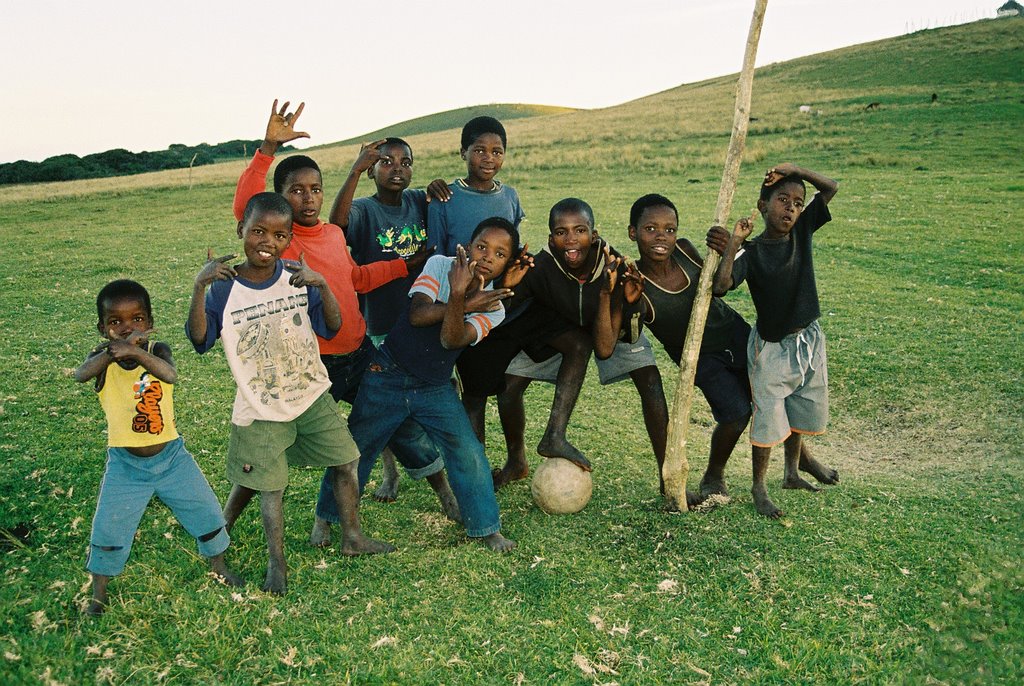
These are photos of the region I liked best in South Africa.Here are some kids I played soccer with in Bulungula. Oh, I didn't have their skills when I was their age.
The houses you see are Rondavel. They are on every hillside of the Transkei.
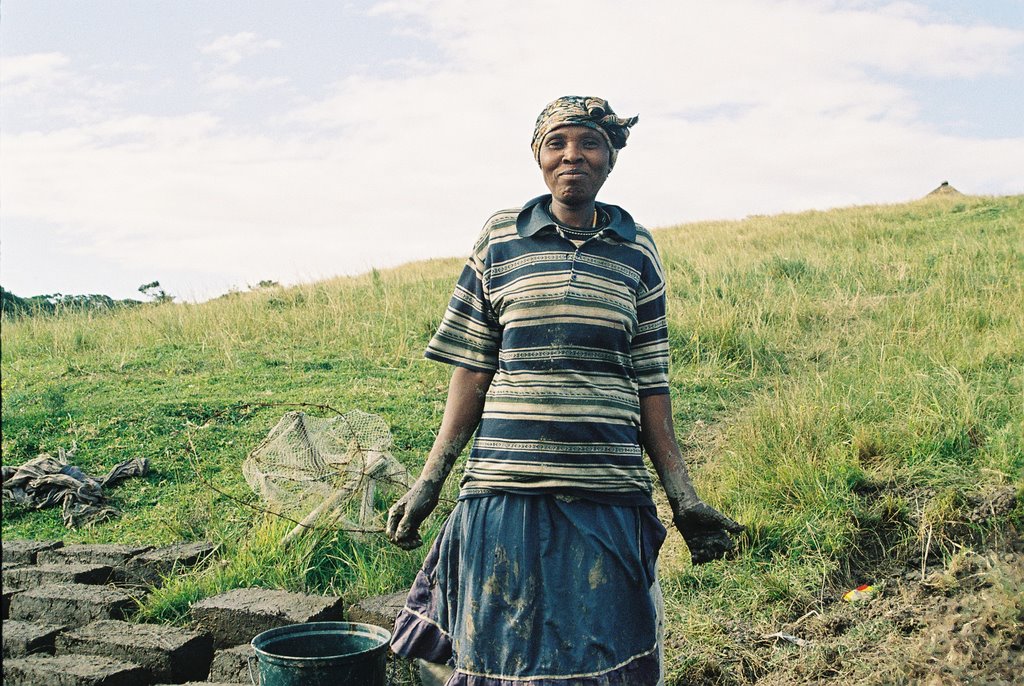
This woman is making bricks out of mud to build herself a new house.

Young man in Bulungula.

Wednesday, August 02, 2006

Finally some photos


They are still not mine, but Laura's. Laura is a great Spanish girl (could also call her a woman) who did the Tsiribihina with me and takes much better pictures with just about the same camera.

Saturday, July 29, 2006

Diego

Still in Diego. I just went to Ramena, Diego's beach, and for the first time in ages, I've been able to sleep, laze around, read, and do all sort of other nothings without feeling guilty that I was missing this and that, and that I was imposing on these people, or that I should try to learn about this other thing, etc, you get the gist. Tomorrow I fly to Tana, my first internal flight of the trip. It takes 20 odd hours in a taxi brousse to get to Tana, and an hour in a plane. Certes, it costs more, but this is my little luxury.
Over the next few days, I am going to look for things to purchase; I am becoming a nice vazaha. And then Mauritius, before I fly home.

Tuesday, July 25, 2006

And finally the North

This is my final area before I go back to Tana and from there to Mauritius and Australia. From Tana, I made for Antsohihy, not sure what I would find there but sure I'd find something. I did: a French man going to Analalava, where he lives with his wife. He invited me to their place after we had lunch together. I was meant to stay a night, catch a boat the next and go visit the islands off Analalava. Didn't happen: the piroguier who was meant to take me made me wait day after day while he tried to resolve disputes with his wife. The result? I lost four days but this is Madagascar and in Madagascar, such things are normal. Nothing works as it should.
Every slightly educated Malagasy I meet has a theory on "what is wrong with Madagascar".

Let's see them.
The people don't care about work. They are lazy, do not obey, steal from their bosses and leave if they are not happy. It can't be true, you say. Sadly it is. Examples abound: I've seen maids who take three hours to cook half a family meal, and who either tell their bosses an outright no, or say yes to their orders, and don't do them anyway. Stealing? One prime example: the Colas is the company that is building roads in the North. Petrol stations have lately been complaining they don't sell as much fuel as they should. Colas employees steal fuel from their company and sell it on the roadside. These instances are not isolated cases. Every employee that can steal steals. Leaving if not happy? The maid of the people I was staying at in Analalava left because they asked her to serve a girl she didn't respect.

Another theory is corruption: everyone is corrupt, it is part of life. One road engineer told me a few stories yesterday. A road is assigned a budget of 100 billion. The company that wins the bid must then give 3 billion to the person who assigned them the bid and 2 billion to the minister of transport, and so on. In the end the road is built with 50 billion and lasts two years instead of ten. Or, you want to get a professional exam. You pay the board and all is well, but pay enough, for if someone pays more and spots are limited, your money will have gone in vain.

Another, vehicled by Vasahas, is culture. Ancestors are too important, and their ways cannot be changed. If their ways cannot be changed, then there can be no progress. How can rice production be increased when cultivators do not want to change their methods, and that when new methods are cheaper in labour and capital?

Just a few thoughts, but I don't get comments anymore on the blog. I still see many visits but no comments...

Saturday, July 15, 2006

Back in Tana

And it is another world. I didn't realise it when I first came. In my mind, Tana was Madagascar, when all it shares with the country is its geography. First, people wear shoes. Then, they wear coats and pants. Third, they speak French and some even speak English. Fourth, many of them have finished school. Fifth, there aren't rubbish piles, ducks, chooks, pigs and sundries all around. Sixth, there are traffic jams, or if you want to see it differently: enough cars to have traffic jams. Seventh, the roads are often made of bitumen. Eighth, people aren't afraid to spend twice the national average daily earnings on a taxi ride, or an a drink in a bar.
I won't go on. I got here following the RN7, the primary tourist axis of the country. Even though I've seen interesting things, the last few days have been marked by a few conversations.

1) With volunteers for various associations. Over the last month and a half, I have developped a distrust of charities, forming the belief they do more harm than good. Volunteers always have heart warming stories doomed before they start. Two medical students worked in a hospital out bush; there a French doctor volunteered his time to lord over the villagers, operating way past his competence without any respect for protocols. A group of medical students from another university were building a school that a covent would administer later; I could see a few problems but nothing major until a few days later.

2) With high officials from the European Commission, and more importantly with a man who had been in Mada for five years equipped with a different perspective on development. His theory; just about every foreign aid project harms the country more than it helps it because it creates parallel institutions and weakens the existing ones, however poor and corrupt. From the others: the EC has too much money for Africa. So as not to reduce next year's budget, bureaucrats throw money at dubious local projects, furthering the harm on the country.

3) With a bourgeois Merina married to a Vazaha woman. Here was a man, a Malagasy, who crossed his legs with his shins parallel to each other, who wrote reports for worldwide organisations, who spoke with great logic, who answered my questions with precise and relevant information, and who produced official reports to further answer my inquiries.

Monday, July 10, 2006

The train ride

My forrays on the beaten path continue. Note that I am one of the rare ones to call this the beaten path. Mada has very little tourism, so one could consider the whole island as off the path. But it is so safe, so easy to travel through that, I must use the word, it all feels normal.

I took the train from Fianar to Manakara and back. This train is the highlight of many a tourist's trip. It leaves early in the morning, making its way east and south through mountains, jungles, rice paddies, banana plantations, past waterfalls and cliffs, over bridges and under tunnels, stopping regularly at villages to load and unload merchandise, be it pigs or bananas, until it reaches the open fields of the East Coast and the coastal town of Manakara.
I woke up early Saturday morning and made my way to the train station to find a very long queue. Happily Florent, a French guy I'd met two nights before and who wanted to take the train, was a little way in front, allowing me to cut the wait by a bit. Still by the time we got the counter, there were no more seated or standing spots in first class, so we had to buy a second class ticket. We made for the platform and the two second class wagons; the first wagon was too full, but the second was even worst so we pushed into the first. Putting down our bags was difficult but we managed. Remembering India, I thought we'd stay near the open door, sit on the sill when the train got going and enjoy the scenery. Looking outside the wagon, I could see there still many people trying to get in. I figured they wouldn't, but damn, was I wrong!

Soon the only way I could move was to shift my weight from one leg to another. I felt another leg on mine, slowly slipping onto my still tender blisters, but I could do nothing. I couldn't turn around, and by looking over my shoulder, I could see the man doing the crime was out of my reach, behind two others. Luckily the chef de gare decided to add a wagon; I asked a guy to reserve a few seats, tipped him, and had a nice friendly ride for the trip. I've described the scenery but that is not the nicest aspect of ride: at every stop, villagers sold various foods, fruits, beignets, cakes, breads, and so on. My pocket was full of 500 FMG notes (about 8 cents), the price of all these things. I ate royally and throughout the whole trip. Hence I recommend this train ride.

Manakara was a pleasant town. Florent provided much of the entertainement. He is a medical student, so imagine the conversations. On my part I enjoyed corrupting him with the ways of Madagascar. First thing we did was to be pushed 3 kms with our luggage by a guy half our size to our hotel for 5000 fmg. Once there, the pousse-pousse driver asked for twice the amount since there were two of us. I refused automatically and categorically, threatening the driver to take him to the police station if he persisted. Florent was torn; it was only 40 cents of a euro more for him. And the man had sweated for our pleasure. He made the right choice and refused the driver's demands. A small matter, but a big change.

Now, I am going North towards Tana.

Friday, July 07, 2006

Hikes in national parks

I am in Fianarantsoa, Madagascar’s second biggest town and the capital of the Betsileo people. The last week or so has been quite different from my previous experiences. I am travelling up the RN7, the nation’s best road, and how I enjoy it! The RN7 is the classic tourist route and for good reason. It is a good road with many attractions. Still there are some aspects I miss from the brousse; I am starting to understand Kurtz in Conrad’s Heart of Darkness. My colonial spirits are awakening: in the brousse, I was a prince. On the RN7, I am a tourist. Children were scared of me, every girl looked at me, and the men called me Monsieur. They were all hoping I would notice them. Now, on this well worn path, I am a normal sight. Not that there are many vazaha, but there are a few when there were none.

I disgress, and for those who see colonisers as oppressors, I am not endearing myself. The RN7 goes past several national parks. I did two, and I think I will stop at that.

First, Isalo, Madagascar’s most visisted park, at twenty and some thousand visitors a year. Isalo’s main attractions spawn from two sandstone ridges dominating the savannah. With a couple of Frenchmen, I walked in and out of the park for two days running. We visited the main tourist attractions; doing anything else is difficult with the guiding system of the park. One needs a guide to visit the park, and the guiding fees for day hikes are per site visited. They add very quickly to considerable sums. Noticing this, we wanted to do a one-night hike. Ah, but the guide was more clever than us. You will need a porter, he said. We added up prices and it was cheaper than what he proposed. You will need to buy food, he said. Not a problem, I thought, until he pulled some outrageous food costs. Error, I believed him. When a few days later I went to the market, I realised he had inflated prices by five times. I should have doubted his words and called his bluff. But I was too polite and didn’t dare call him a liar. The burden of education...
The sites were interesting, if too arranged for my taste. The most famous one, the piscine naturelle, would have belonged in a garden of the very rich. Very beautiful, yes, very natural, no. What do I mean by arranged? Cement on the paths, steps carved out of the rocks, and rails on some of the trickier sections.

My second park, the Andringtira, was an excercise in contrasts. The paths were arranged but inconspicuously. Granite rocks were laid across the paths to form steps that blended into the scenery. After Isalo and a mild disappointment, I wanted to go to Andringtira but didn’t know how. The park is not on the RN7 but a little way away and my budget is tight. And here comes the perpetual luck of the traveller: I met a French stagiaire of ANGAP, the governmental association running the national parks and reserves of Madagascar, who had been offered a trip up Pic Boby, Madagascar’s second highest peak, and highest accessible peak. (The other peak has not been climbed yet. Too difficult. I can think of a few people that would interest.) Together, we made for Ambalavoa, met people of ANGAP, and were taken to the park, where an agent waited for us and took us up on a splendid two-day hike. All of this for free.
The landscapes of the Andringtira have been described as lunar. I put up pictures on this site that make me think more of the moon. Instead, I would qualify them as stark: granite mountains eroded by endless rains and winds into a variety of shapes. Some harsh cliffs, and others that look like caricatures of noses. The agent who took us up had twelve years of experience in the park. He had helped build all of the paths, and he was the one ANGAP trusted with taking the big shots up. Whenever we ran out of breaths, he paused to point out a plant and explain its importance in the region. Whenever we stopped for lunch or to make camp, he rushed around to prepare a fire for the rice and sundry. That we cooked him two meals surprised him greatly: why were vazaha helping? Power relationships are important here, and as vazaha, we are perceived near the top regardless of our background.
The second day, after a very cold night, we climbed Pic Boby. The ascent was hard but worth the effort. Once I develop the film, I will try to post some photos here.

Now I am in Fianar, about to take the train to Manakara tomorrow. This is a classic trip, which makes me cringe a little, but it has been highly recommended to me by every traveller who has done it.

Thursday, June 29, 2006

From another world

It has been some time since my last post and for good reason. I have been deep in the brousse, far from any computer connected to the internet. In my last post, I was looking for a way to get out of Morondava, the capital of the West but a bit of a hole in itself. I eventually settled on a motorboat to Belo sur Mer, the last of my technological forays in ten days. In two hours on the sea, I made a third of the way to Morombe. The other two thirds took me three days, or four if you count the day with no wind. But I am getting ahead of myself; first Belo.

A tiny village with two main attractions. The first involved an 8 km walk inland past saltines, to a baobab forest. The West is full of baobabs, these magical trees better suited to witch forests than to the incredible biodiversity of Madagascar. Among the trees stood a village, empty for its inhabitants were working the saltines. So there I was, in a witch forest and a deserted village, walking around as the sun set. And the sunset across the saltines turned them to gold!
The other attraction is shipbuilding; they build boutres, pronounced boutchi, boats coming from another age, which of course I had to take. I arranged to go with a cargo boutre to Morombe, a village (some would say a city) on the West Coast. None of the crew spoke French and I didn’t speak Malagasy. After a difficult negotiation, I was picked up at five in the morning Malagasy time, or 6.30 am our time. We spent three hours trying to get out of Belo but failed, the wind not being good enough. I was ferried back; the next day we managed to leave, taking three days and two nights to reach Morombe. Two nights at sea, my first two, but on what a ship!
I wonder what you imagine when I say boutre. Understand that boutres could have been built five hundred years ago. The only aspect of modern technology is the plastic of the two on-board buckets. Everything else, from the metal (pig iron) to the ropes (some natural thread), and the masts (almost straight trunks) speaks of an economy that hasn’t seen either the first or the second industrial revolution. To climb up a mast, crew members take hold of ropes and cables, and pull themselves with the strength of their arms, using the gap between their big toe and the second toe to push with their legs.
The crew was friendly, rarely asking me for cadeaux, instead intent of keeping me happy. Food was perfect for a shock diet: rice with water in the morning, rice for lunch, and rice with water at night. No condiments, no salt, no pepper. The water had more taste than the rice. I ate half the food as the rest in twice the time. Ten meals like this and I wanted anything but rice.
But I was in the brousse; there wasn’t much but rice.
Once in Morombe I went down to Andavadoaka where an English charity, Blue Ventures, does conversation work on the reef. Volunteers, all English speak, dive every day, so if diving is your thing and you need to help the world, look them up. Did I say most of them were English? That entails one thing: massive binge drinking, on an Australian scale. It was pitiful; we went out to a bar; to dance, the English needed to drink. Compare that with the Malagasy pulling the weirdest move (wonderful in their way) after no alcohol…
Once back in Morombe, I went to a ball, another great display of Malagasy dancing. It was grand in a poor way. The next day I caught a taxi brousse to Tulear, hoping to make it for the fete de l’Independence. After all, Tulear was only 280 km away and it was 10 am. The fete was the next day. Error! I made it to Tulear in 28 hours. We drove through villages with nothing; a few huts, no well, a couple of zebus, and a few chooks. We stopped for a few hours sleep in such a village; there I met an Indian man, probably the richest in the village. He took me to his house; wobbly concrete walls, fragmented cement floors, three rooms, and a TV with satellite reception. He offered me chocolate and some water, together worth more than people earn in two days, and he told me: “We have it good here. We live like kings.” I agreed, kings among beggars. He needed my company because his wife and baby had gone to Tulear. The baby had started vomiting and had diarrhoea, the signs of cholera. Kings, indeed!
I am in Tulear, recovering from some hard days, enjoying a big city (some would call it a large village). Soon I will be heading inland, towards national parks and hikes. I hope to catch the France-Brazil game.

Friday, June 16, 2006

Morondova

For some reason an entry I wrote days ago is not going through. Strange. I hope this will push it.

I am stuck in Morondova. Not really stuck, but the ways out don't suit me. Fly, rent a car, or do the long way around. I am waiting for a boutre, a kind of sail boat to leave in the right direction. Come on Morombe!

Wednesday, June 14, 2006

The Wild West

From Tana, I headed West to Antsirabe first. Outside the taxi brousse station, I was attacked by a horde of pousse pousse drivers, all wanting my custom. Men weighing half my weight, wanting to carry a friend and me, plus our bags. And they did: a little man lifted his pousse pousse and ran along to town, and on to the next station. There we waited for an hour or so for the taxi brousse to leave for Miandrivazo. I say we as you notice: I met a Swiss guy in Tana, Nicolai, and we did part of the road together.

Catching a taxi brousse is an interesting process. Rock up to the station and hope one leaves soon. How soon? A few hours is soon, but it might as well leave tomorrow. Yesterday I crossed a river and asked after the taxi brousse. Hands pointed me in the direction of a big truck. No, not that one, the truck driver said. He pointed in front of him to a very old ute. That? Yes, yes. I looked at a sort of old 4L, with its back cut off, blue paint peeling off the body. I went to a few ladies near it. This is the taxi brousse for Morondava? Yes, yes. Leaves today? Hmm. Today? No, tomorrow. Tomorrow! Yes, tomorrow, early. Is there another leaving today? Ah, no. Where is the driver? Ah.
I went to look for the driver, but was told he was across the river, getting a piece to repair the car. I went back to the ladies by the car. You are going to wait here for tomorrow? Yes. Here? Yes, with our prawns. They show me a cold boxes of prawns they will sell in Morondava. You will sleep here? Yes, here. Where will I sleep? Here, they said, pointing next to my bag.
There was no hotel, I had to sleep there, but soon a car of vasahas came through and I begged for a ride. Not quite that hardcore.

Back to Miandrivazo. There, I went canoeing down the Tsiribihina (where one must not dive) for three days. I was taken out of the world: life moved at a different rhythm, that of the river and its flow. I went through villages whose only links to the world were canoes like ours. The second night, we camped on a deserted island. Just before sunset, a herd of zebus crossed through on to the mainland.
After the descent, Nicolai left back to Tana to catch his flight out. With the other vasahas of the trip, I made for Bekopaka, or the village of the Tsingy. You may have heard of the Tsingy (pronounced Tsing): rock formations seperating two worlds, one below and one above. National Geographic and Nicolas Hulot made pictures of the above famous.
We didn't want to rent a 4wd, so we took the camion brousse. Few vasahas do that: we were an attraction! The camion brousse was a truck loaded with merchandise, rice and people, all stuffed in the back. I was sitting with my legs dangling outside, my thighs cut by the edge of the back flap, my bottom precariously rested on books I piled, a bit of rice, and a spare part of a car. The road was terrible: with my hands I held on as I could. The first truck I was in broke its transmission, the second only punctured a wheel.
Still the ride was exhilarating: I learned Malgash, I screamed Kouryahbe (phonetic translation) out to passing locals and laughed at their smiles and their Tsara e, I spoke to an ex Ministre, and to a wannabe politician, I ate in a local road stall, and watched baobabs run along the road. My stomach accepted the beating with grace.
The Tsingy were wonderful, especially the big Tsingy. The three I travelled with had to go back after the little Tsingy, but I was able to hitch a ride to the big Tsingy with a group of Swiss Germans who had rented a car. I don't have photos, but look them up on the internet for your viewing pleasure :-)

I made my way back hitching rides with vasahas since all the taxi brousses were broken. The road is that bad. Now I am in Morondava. I will try to make my way to Tulear soon.

Sunday, June 04, 2006

Tana coming to an end

Through its nightlife, I've come to like Tana, the capital of Madagascar. Last night, I was taken out by a guy I met in a restaurant. As he put it, whenever he goes clubbing, he takes a new girl back to his hotel.

The first nightclub we went to was full of beautiful women, all ready to dance, all ready to speak, all ready to have fun. Some, many, expect a cadeau at the end of the night, but when I've avoided these girls, spoilt by rich vasahas, I've found normal Malagasy have the same love for life.

This world is different. In India, I could never go out, and in two months of travel, I spoke at length to two local women. In Australia, men women interactions are hindered by a strong Christian tradition. Only in Madagascar have I seen raw desire. Yes, desire for sex, but not anonymously. Women desire to dance, to have fun, to laugh, to talk; they live for a lust we westerners chose to ignore.

I am no longer shocked by the spectacle of old vahasa and young Malagasy women. Why? Because I see these girls enjoy themselves. If they like it, is there anything wrong with it? They know these men will love them for a week. They know that they have families back home.

Reading what I've written, I seem to imply I've accepted what happens here. I haven't, but I'm getting used to it.

Tomorrow I leave towards the Tsingy, the famous rock formations. It'll take me a week to get there. I will take taxi brousses, canoes, hitchike, and walk.

Friday, June 02, 2006

Bloody AZERTY! It looks like a good combination with more options than QWERTY but I keep on typing commas instead of m's and q's instead of a's...

I am in Tana in Madagascar. Because of this keyboard, I am not going to give you a story but rather a series of anecdotes and impressions.

The national airline is called Air Mad. They changed the name years ago from Mad Air.

When I arrived at the airport, I was glad to see that lines were not respected. Stand behind the yellow line? not in this country! I had a silly smile as I walked through customs. The custom officer told me that if I waited, he would take me to town for 100k fmg. I smiled and left, changed some money while fending off taxi touts, and finally readied myself to find a taxi. The information office quoted me some exhorbitant price, so I walked out of the terminal.
Taxi, 30k Ariary
Oh no that's too much
Come, come, I am official taxi
(Other taxi drivers join us)
It's too expensive, a friend (i invent him on the spot) told me between 10 and 15
15 here
14 here
12, come with me now, I take you for 12

The benefits of open competition

Malagasy people are friendly and very beautiful; I can honestly say there are more pretty girls here than anywhere else I've been. Unlike India, they are very open and quite flirty. Yesterday I went to a restaurant where I met 2 French guys and a Malagasy woman. It took me some time to understand that one man who had the looks of q friendly pappy was married to the Malgash woman. She was only 27. As one French guy put it: we all have wives 30 or 40 years younger.

I went to a cabaret with them afterwards. 10 girls to a man, all prettier than each other. Professionals I was told. If they dress like western girls, they're professional. One of the, approached me, and I couldn't say no to a conversation. Besides if she approaches me, she is flirting with me, and she is free. Morals get blurry. I understood half of what she said. Apparently I was married to the only normal Malagasy woman in the room, and I was going to buy her a drink, as dictated by my wife. Confusing times but a man is waiting for the internet behind me.

Tuesday, May 30, 2006

My search for Africa

"This is the real deal," I heard and I agreed. There I was watching a gay white sangoma dance with a black colleage and an apprentice while a village sung them on. I was in Bulungula. It had taken me some time to get there.

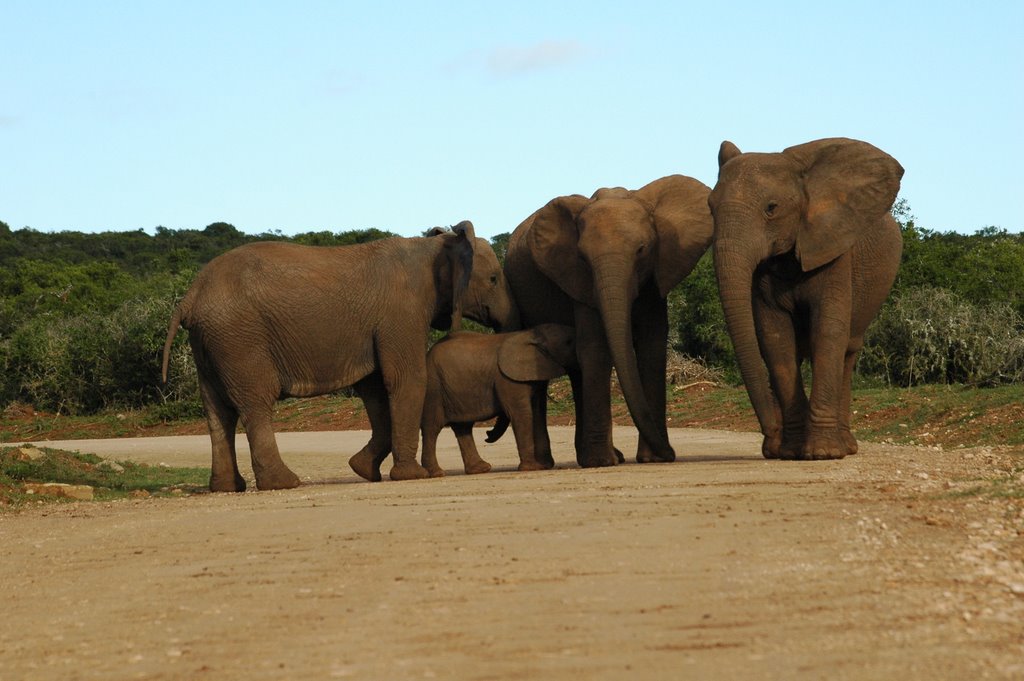
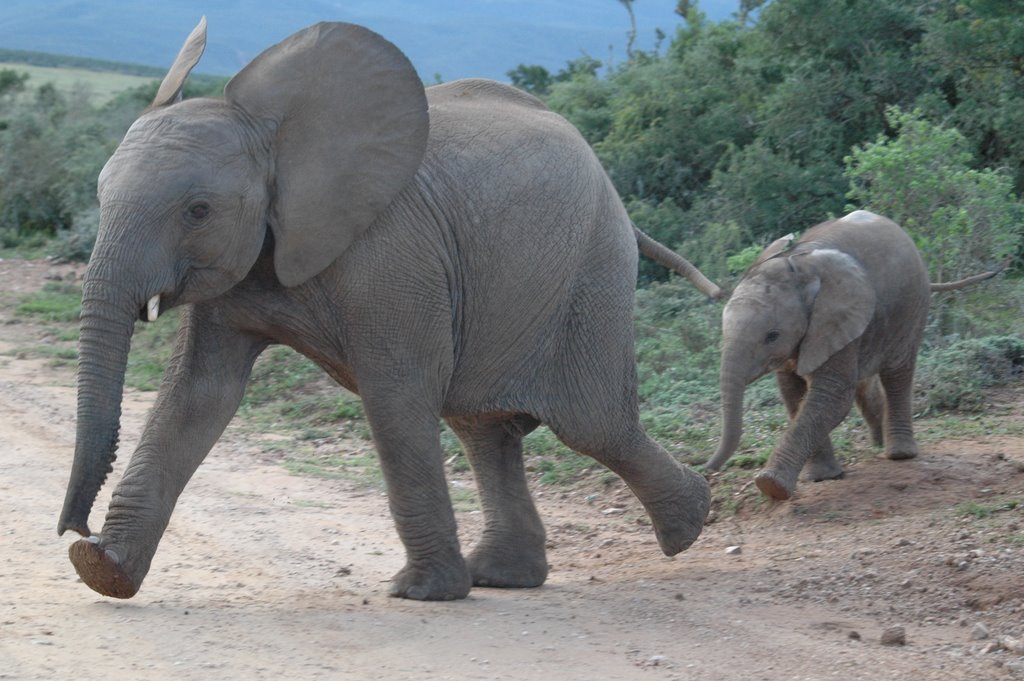
Since the Garden Route and its European vibe, I've tried to come in contact with what I perceive as real Africa. First, I headed for Addo Elephant park. I met Nils, a Dutch guy travelling alone. Together we rented a car and drove to the biggest elephant park in the world. 400 elephants roaming freely on an area bigger than many countries. For two hours we contented ourselves with wild pigs, deer-like animals, and colourful birds. But then we found them: elephants at a distance, we were happy with our fate. We drove on, spotting a few behinds, until we reached the end of a road. Turning back, we got caught in the middle of an elephant herd. Fifty giants crossed the road in front and behind us. A male first, proudly heading for me, veering at the last moment to my relief. And then the females and their cubs. Again and again, and everytime they crossed, they eyed my movements. Picture an animal twice as big as our car judging whether I am a danger to his herd. I was glad to pass the test. Since Nils had a great digital SLR, I am able to add a few pictures on this blog.

I parted ways with Nils at Umtata, capital of the Transkei, home of the Xhosa. Xh is a click sound. From Umtata I headed for Coffee Bay. If the journey to Coffee Bay felt like real Africa, the backpacker I stayed at ruined the impression. Wild parties with enforced drinking rules, I've left these days behind. I was caught in an immature party until I left for Bulungula. I took advantage and learned surfing, standing up many times on the white water, and once on a small wave. I was stoked.

I've mentioned real Africa (and what is real, you will ask) but have not described the Transkei. The Transkei was an independent republic during apartheid in which many Xhosa were forced to live. The republic was only independent in name. Because it was independent the apartheid government was able to ignore its infrastructure and educational needs. As a result of this, 12 years post apartheid, the Transkei is still wild, and the ways of the Xhosa are preserved.The land is a series of rolling hills dotted with colourful rondavels. The dots, homes of the Xhosa, are rarely clustered. Instead, they grace individual hilltops. Their green and pink colours make them stand out across the landscape. The resulting picture is beautiful. Since my pictures are on film, I can only tell you to google Transkei and see the result. But fear not, as soon as I've developed my film, I'll proudly display them to anyone and everyone.

In Coffee Bay, I felt enclosed in an immature party, I've mentioned. The cultural attempts of the coffee Shack, my backpacker, were even more pitiful. We were taken to a headman dinner. There, a menu was rolled out, and a drunken staff member of the Coffee Shack directed the proceedings. First the girls dance, nubile and topless, for the pleasure of the males in the room. Then the boys take over, food is served, q&a time, and more dancing. I am not a fan of shows, and I found this event distasteful. Still I was happy to have come in contact with some of the Xhosa culture. I didn't expect Bulungula.

Through Gill's sister, I'd heard of Bulungula and decided to check it out. After a short shuttle from Coffee Bay, I waited about an hour in a roadside restaurant where no one spoke English, and kids eyed the whitie. Soon a landrover picked me up, Dave, the owner of the place, at the helm. The car was not overkill. The road we went down are so bad that cops don't go into the village. But the roads are worth it: the lodge is magnificent. Still a beautiful lodge is not enough in South Africa. What makes the place special are two things: the community owns 40% of the lodge and uses it as a place to socialise, and the owners take an active part in improving the community whilst preserving their culture. When I was there, three nursery specialists were looking for a site to create a local nursery, hence creating employment and improving nutrition.
One of these specialist was a white Sangoma. A white Zimabwean of wealthy descent, he left everything behind to answer the call of the dreams and become a Sangoma. He claimed to feel the ills in a room. I am not sure I believe him: he told me which girls had their period but I didn't feel comfortable enough to ask them. And when I asked him whether anything was wrong with me, he said no. In fact, I had a sore throat. But perhaps his mind was confused by his gayness. "I am not attracted to gay men," he told me, puffing on his joint. "How do you do it then?" I asked foolishly. "I seduce straight men," he answered looking at me. I was torn between getting away as fast as possible and learning more about Sangomas, and the Xhosa culture he has embraced. Luckily, that was the extent of his flirting and I was able to talk about other things.

The next night, the local sangoma decided to hold a dance in his honour. She decided to use the lodge for the dance, not because she wanted to entertain the few white guests, but because the lodge is the best place to socialise in the village. The ceremony started by thanking the ancestors, and then sacrificing a chicken to their spirit. A trainee sangoma lead the chants, and the crowd responded, clapping to the drum beat. The sangomas danced themselves into trance for the best part of an hour. The scene was magical, incredibly foreign, and not meant to entertain ME, the white visitor. It was for the community and I appreciated it better for it.
Tomorrow I leave for Mauritius and then Madagascar. I am still not sure what to expect.

This is the site of the lodge: http://www.bulungula.com/It doesn't do the place justice.
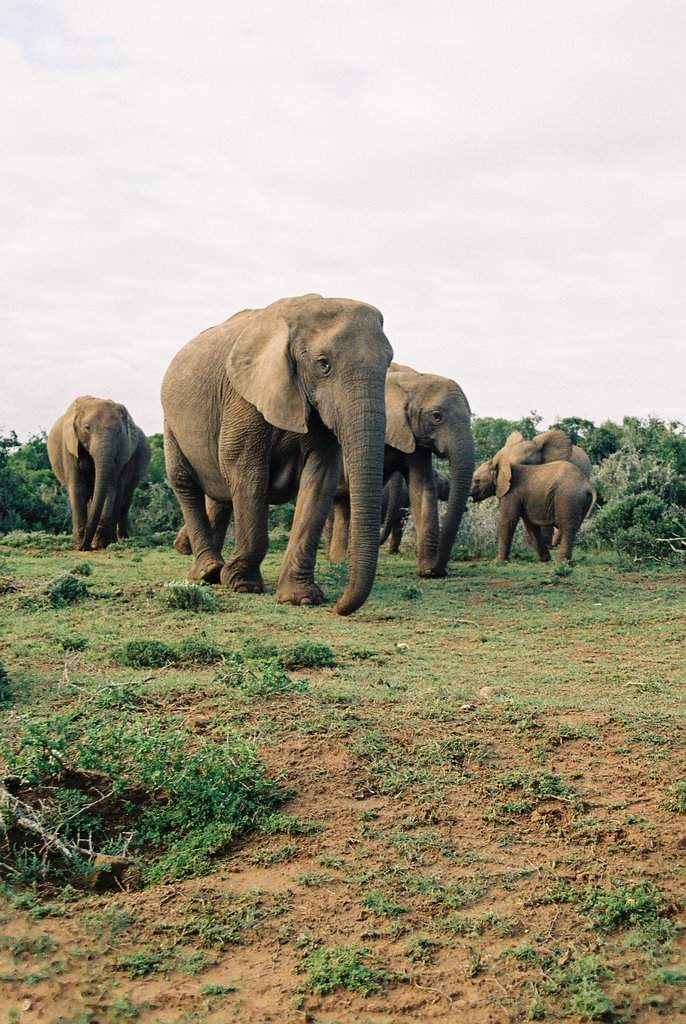
From Addo


Monday, May 22, 2006

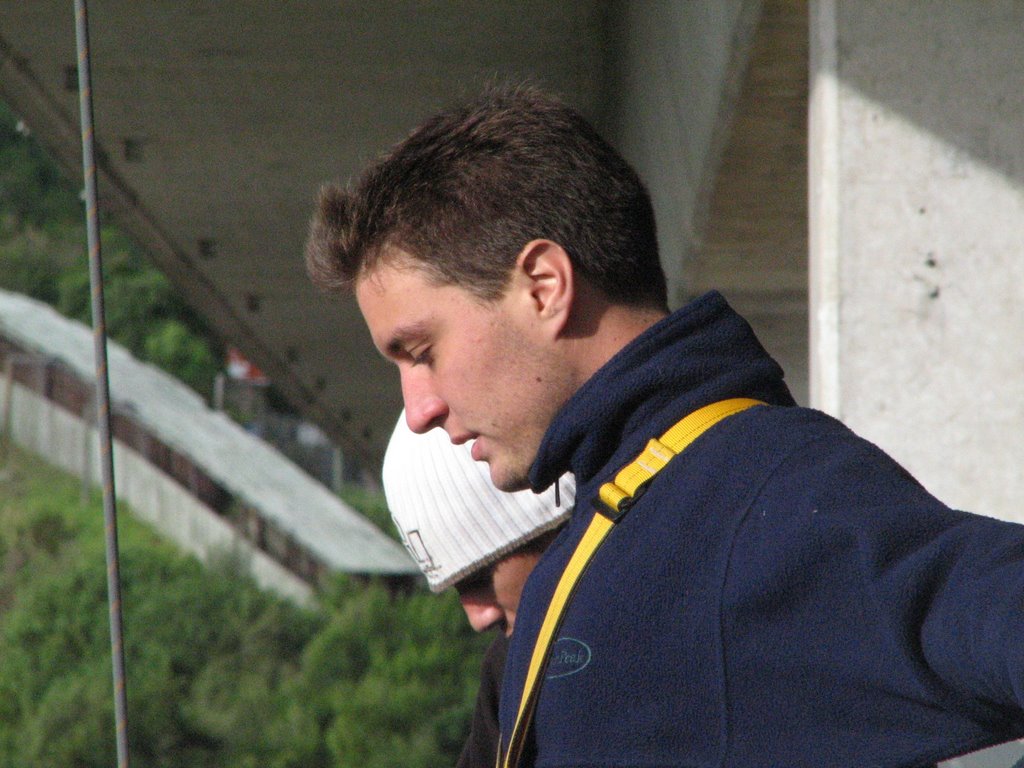
Yeah that's me!

I am thinking: this is crazy.

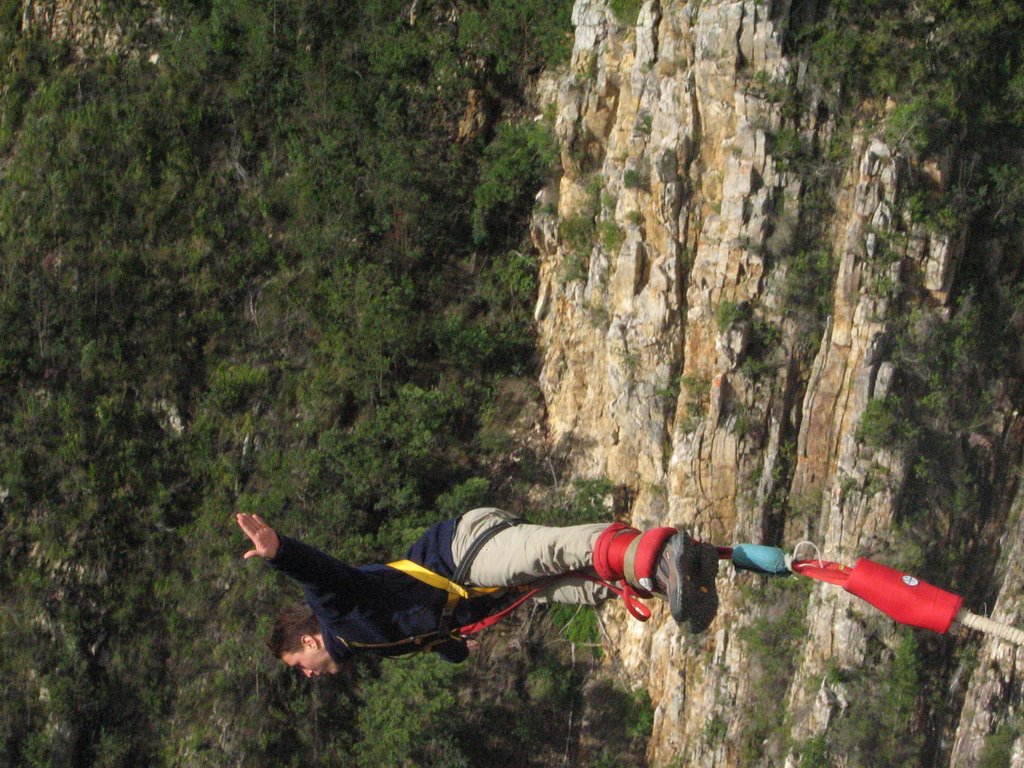
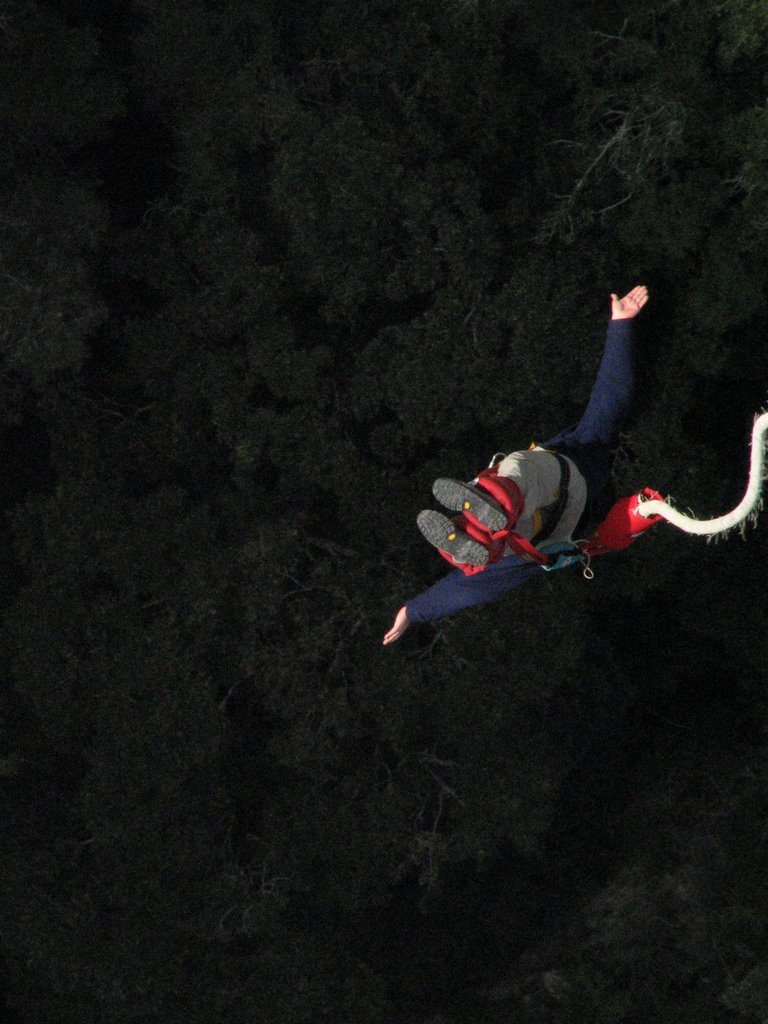
Boulkans Bridge Jump

Garden Route

Yesterday I wrote a really witty entry and the computer crashed. So you'll have to do with this one.

I find myself in an internet cafe in Plett, short for Plettenber Bay, about six hours east of Cape Town. I am in the middle of the famous Garden Route, but not for long: this afternoon, I leave for Port Elizabeth. There I will do Addo Elephant Park, where I hope to see the big five.

How did I get here then? Through a friend of a friend of a roommate of Gill, the person I was staying with in Cape Town. Joe, the person I drove with, had just worked a night shift, and needed someone to drive him to Plett, where he was doing a sterilisation drive with the SPCA. While he slept in the back, I spoke to the SPCA anesthesologist, a Xhosa man. He taught me the three clicks in his language. I didn't know the way I called dogs, and the way I reprimanded cats were actual sounds in an African language! Chief, the name of our anesthesologist, is a wealthy man: 17 cows, two houses, and two round huts back home in Umtata in the Transkei.

I was dropped off in Knysna, half an hour before Plett. I'd heard it was nicer than Plett, but I disagree. The man running the backpacker there was more interested in his book than his guests, and the streets were quite unsafe.
I am very interested in the racial interactions in South Africa. Since the distribution of wealth closely follows the colour of one's skin, I permit myself to quiz everyone about their views on racial tensions. And they answer happily. A black man was telling me of the time he presented a debit card to a shop. The girl at the counter looked at him suspiciously and called her manager.
A coloured girl told me she didn't like black guys. Only coloured and whites.

I left Knysna with a French girl and her mother. We tried a hike but it didn't work: the rain stopped us. Soon I was in Plett, where I lived the backpacker life: beers, wine, people ready to party, a cosy fire, a pool table, smoke filled rooms, and bunk beds. Plett has a better feel than Knysna. Less fences, dark streets, and security gates.

Yesterday, I did the world's biggest bungy jump! 216 meters, wow! Looking down I was more than a bit scared, but hey, I had to jump. I have some photos I'll try to post now.

Tuesday, May 16, 2006

Cape Town proper

I am in the University of Cape Town's commerce labs, and I've only got a couple of minutes to comment on this great city. I've been lucky: I have a friend here who has been more than helpful. When she hasn't pointed me in the right direction, she's taken me there.
And there are so many nice places to go. Cape Town surrounds a mountain on a cape, which is also a peninsula. There are beaches on both sides, and beautiful hikes and views all around. The appartment I'm staying in is right against the mountain, just above the CBD. I wake up to a sweeping view of the mountain, Lion's Head, Signal Hill, the CBD, and in the distance Robben Island. It's hard to ask for more.
Temperatures here aren't bad for the time of the year. With a polar fleece I manage alright. I was warned about security, and although it's not as safe as Australia, it's not as bad as I was told. Gill, the friend I am staying, had her car broken into when we were caving up a mountain, but nothing taken. It was more an act of vandalism than anything else.
There is quite a disparity of wealth. For the rich, life is only marginally cheaper than Australia. But others make do with salaries of R100 a day. That's about AU$20.
Because of this, rich South Africans are spoiled. I was a little stunned when Gill told me not to clean up since the maid was coming the next day. In an appartment of students, a maid? When the maid came, I talked to her: she lives a little way past the airport, in the slums of town. It takes her three hours to get to work. Her Monday was eleven hours long: six in transport, five of actual work.
Now this may sound outrageous to some of you, but it's much better to have servants than not. They're paid a pittance by our standards, but not by theirs. They'd rather work than be punished by our misguided social conscience. And if you want to pay your maid more, why not? But you'd do better if you employed another, say a gardener. Better spread the wealth than localise it.

Cape Town was colonised in the 1600s. It's part of New World, but not in the way of Australia. There are many old and charming buildings, houses with characters, museums of real interest here. Today I was walking in the stunning botanical gardens, which spread from the foot of the mountain. They were gifted to the nation by Rhodes, a name I hear almost as much as Mandela's.

Soon I will leave for the Garden Route, and after that for the Transkei.